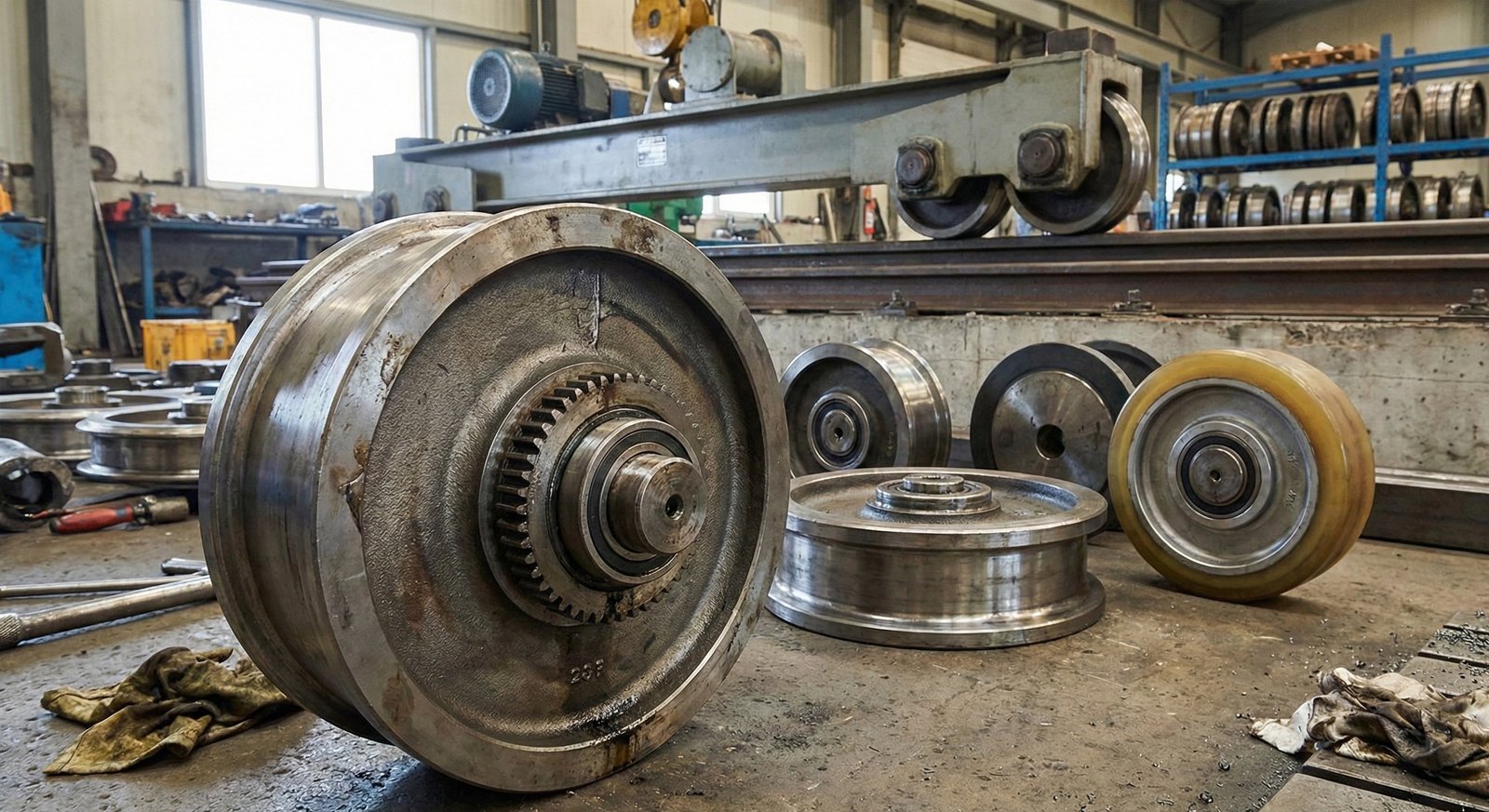
Common Causes of Crane Wheel Wear
Crane wheels are high-wear components, but they shouldn't be wearing out every few months. If you find yourself replacing wheels frequently or noticing excessive flange wear, it's a sign of an underlying mechanical issue. Ignoring these signs can lead to rail damage and dangerous derailments.
1. Crane Skewing (Crabbing)
Skewing occurs when the crane bridge does not travel perpendicular to the runway rails. One end moves faster than the other, causing the wheel flanges to grind against the rail.
Causes:
- Drive motors not synchronized (in dual-drive systems).
- Uneven brake adjustment (one brake dragging).
- Worn drive wheel diameters (one wheel smaller than the other).
2. Rail Misalignment
Even if the crane is perfect, a bad runway will destroy wheels. Rails must be straight, level, and parallel within strict tolerances.
Signs:
- Span Variation: The distance between rails varies along the runway.
- Elevation Difference: One rail is lower than the other, causing the crane to drift to the low side.
- Rail Joints: Poorly aligned joints act like a hammer, chipping the wheels.
3. Mismatched Hardness
There is a golden rule in crane design: The wheel should be harder than the rail.
If the wheel is softer than the rail, the wheel wears out rapidly. If the wheel is too hard, it will wear out the expensive rail. Typically, wheels are heat-treated to around 300-320 BHN, while rails are slightly softer.
4. Bearing Failure
A seized or failing wheel bearing will prevent the wheel from rotating freely. This causes the wheel to drag along the rail, creating flat spots. Once a flat spot forms, the repetitive impact causes further damage to both the wheel and the rail.
Troubleshooting Checklist
| Symptom | Likely Cause |
|---|---|
| One flange worn | Rail misalignment or skewing |
| Both flanges worn | Rail span too narrow |
| Flat spots on tread | Dragging brakes or seized bearing |
| Rapid tread wear | Wheel material too soft |
Pro Tip: Always replace wheels in pairs (both drive wheels or both idle wheels) to ensure equal diameters and prevent skewing.