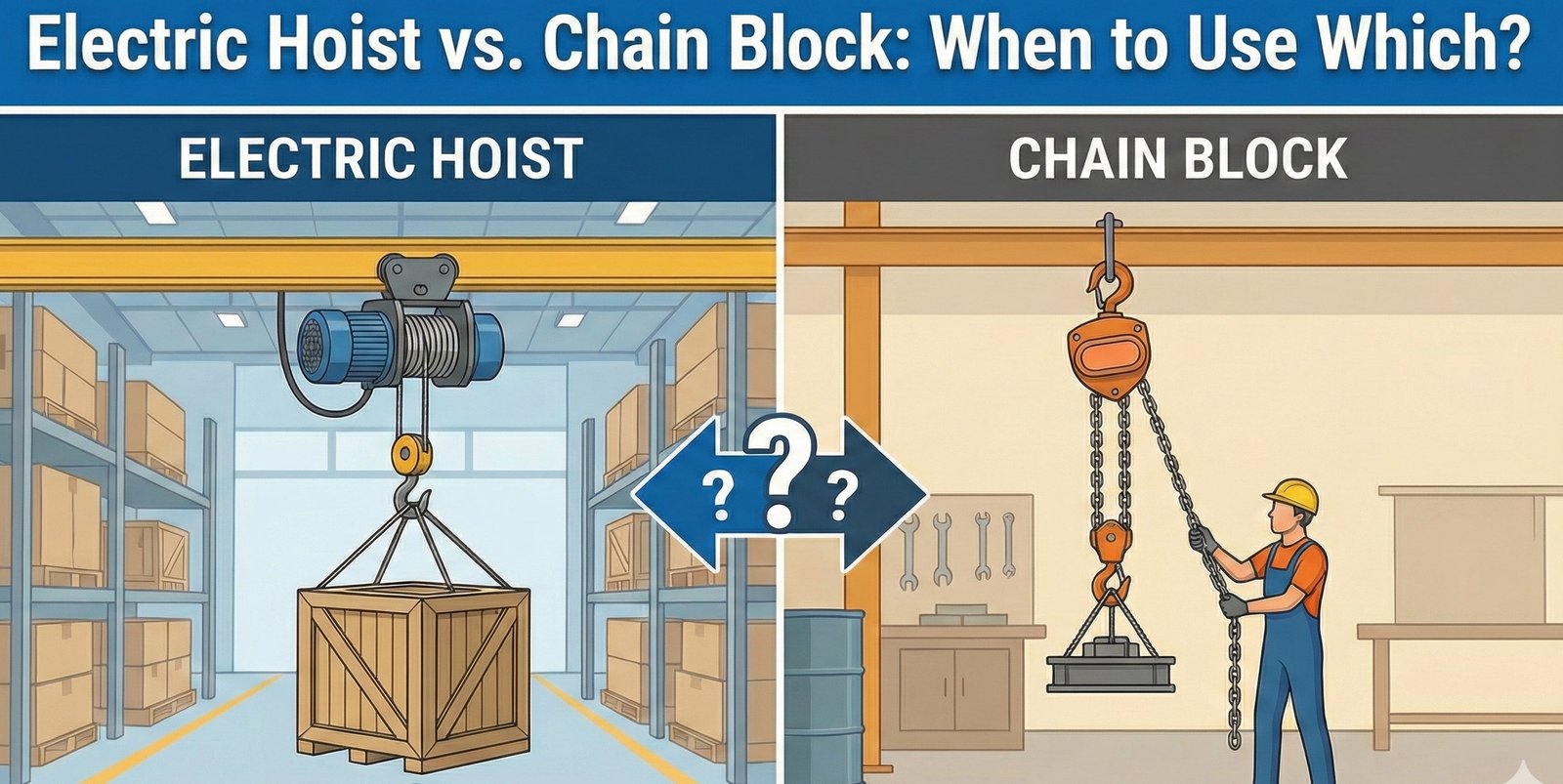
Electric Hoist Buying Guide: Chain Block vs Wire Rope Hoist
Quick Answer
Choose a manual chain block for rare maintenance lifts, an electric chain hoist for compact low-to-medium capacity lifting, and an electric wire rope hoist for EOT cranes, higher duty, longer lift, faster speeds or production use. Compare capacity, duty, headroom, speed, brake, rope/chain, motor, control and spares before comparing price.
This guide is for buyers who need to decide what type of hoist belongs on a jib crane, monorail, underslung crane, single girder EOT crane or double girder EOT crane. The wrong hoist choice can create slow production, poor hook approach, high maintenance cost or a quote that looks cheaper only because the duty and components were underspecified.
Fast Selection Rule
Manual chain block
Use for occasional maintenance, low travel frequency, low speed and low budget where operator effort is acceptable.
Electric chain hoist
Use for compact lifting, moderate capacity, shorter lift heights and lower headroom needs where production is not severe duty.
Electric wire rope hoist
Use for EOT cranes, higher capacity, longer lift, faster speeds, heavier duty and frequent plant operation.
1. Manual Chain Block (Chain Pulley Block)
A simple, mechanical device operated by pulling a hand chain. Gears multiply the force, allowing a person to lift heavy loads.
Pros:
- Cost: Extremely cheap. A 1-ton chain block costs a fraction of an electric hoist.
- Portability: Lightweight and requires no electricity. Ideal for construction sites or remote areas.
- Precision: Excellent for very slow, precise positioning (e.g., aligning an engine).
Cons:
- Speed: Very slow. Lifting 1 meter might take 30 seconds of pulling.
- Effort: Physically demanding for the operator.
- Duty Cycle: Not suitable for frequent lifting.
2. Electric Wire Rope Hoist
A motorized hoist that uses a wire rope wound around a drum. It is the standard for most EOT cranes.
Pros:
- Speed: Fast lifting speeds (4 to 8 meters/minute or more).
- Productivity: Can perform hundreds of lifts per day without operator fatigue.
- Capacity: Available in capacities up to 100+ tonnes.
Cons:
- Cost: Significant investment.
- Infrastructure: Requires a power supply and a beam/crane structure to run on.
3. The Middle Ground: Electric Chain Hoist
If you need the ease of electricity but the compactness of a chain block, consider an Electric Chain Hoist. They are cheaper than wire rope hoists and great for loads under 5 tonnes.
Comparison Table
| Feature | Manual chain block | Electric chain hoist | Electric wire rope hoist |
|---|---|---|---|
| Lifting speed | Very slow | Moderate | Moderate to fast |
| Frequency of use | Occasional | Light to regular | Regular to heavy production |
| Power source | Manual effort | Electricity | Electricity, usually with crane controls |
| Best fit | Maintenance lifting | Workstation, jib, monorail, light crane | EOT cranes and higher duty handling |
| Main buyer risk | Too slow for production | Underspecified duty or chain wear | Vague make/model, rope, brake or duty basis |
Hoist Specification Fields to Put in Your RFQ
| Field | What to ask | Why it matters |
|---|---|---|
| Capacity and reeving | SWL, falls of rope/chain, hook block details and reeving arrangement. | Affects lifting speed, rope/chain load, headroom and serviceability. |
| Lift height and headroom | Required hook travel, available headroom and minimum hook approach. | Can decide whether standard, low-headroom or double girder arrangement is needed. |
| Duty and starts | Operating hours, cycles/starts per hour, load spectrum and mechanism duty class. | Prevents buying a light-duty hoist for production service. |
| Speeds and control | Hoist speed, creep speed, VFD/dual speed, pendant/radio/cabin control. | Controls productivity, positioning accuracy and load swing. |
| Motor and brake | Make, kW, insulation, enclosure, brake type, torque basis and fail-safe behavior. | Motor and brake selection affects safety, downtime and maintenance. |
| Rope/chain and hook | Wire rope construction/grade or chain grade, hook grade, latch, sheaves and certificate. | Diameter or chain size alone is not enough for comparison. |
| Spares and service | Brake liners, rope/chain, limit switches, contactors, bearings, seals and local support. | A cheaper hoist can become expensive if parts are slow or unavailable. |
Red Flags in a Hoist Quote
- "Standard hoist" without make, model, duty, motor and brake details.
- Capacity stated but lift height, headroom and hook approach not confirmed.
- No duty class or starts-per-hour basis for production use.
- No brake torque, fail-safe description or test evidence.
- No wire rope construction, chain grade, hook details or certificate requirement.
- Spare parts, service support and substitution rules not stated.
Copy-Ready Vendor Clarification Message
Next Step
Verdict: Use a Chain Block for maintenance (lifting once a month). Use an Electric Hoist for production (lifting every hour).