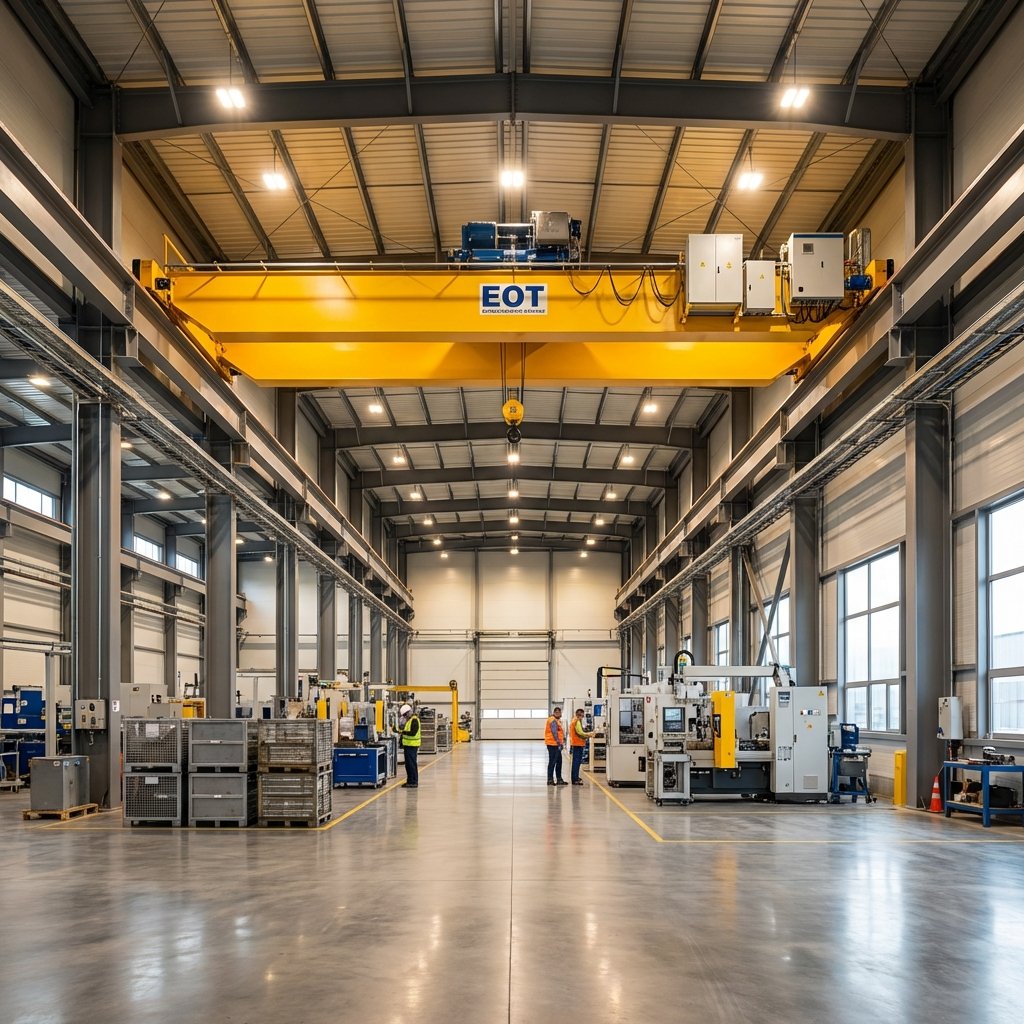
What is an EOT Crane? The Definitive Guide
Quick Answer
An EOT crane is an electric overhead travelling crane used to lift and move loads across a factory bay. Buyers should define capacity, span, lift height, duty, speeds, controls, power supply, safety devices, runway condition, installation scope, and acceptance requirements before asking vendors for prices.
The Electric Overhead Traveling (EOT) crane is the backbone of heavy material handling. From small manufacturing units to massive steel plants, these machines lift what forklifts and manual labor cannot. This guide covers everything from basic working principles to selecting the right duty class.
In this guide:
1. What is an EOT Crane?
EOT stands for Electric Overhead Traveling crane. It is "Overhead" because it travels on elevated runways, keeping your floor space clear. It is "Traveling" because it moves across three axes to cover every inch of your rectangular floor area.
Hoisting
Vertical movement (Lifting/Lowering)
Cross Travel (CT)
Crab movement across width
Long Travel (LT)
Bridge movement along length
2. Deep Dive: Key Components
An EOT crane is more than just steel beams. It is a complex assembly of mechanical and electrical systems. Here is what matters most:
A. Motors: The Powerhouse
Cranes typically use Slip Ring Induction Motors or Squirrel Cage Motors with VFDs.
- Crane Duty: These are not standard motors. They are S4 or S5 rated for frequent starting/stopping (150+ starts per hour).
- VFD (Variable Frequency Drive): Modern cranes use VFDs for smooth, stepless speed control. This prevents load sway and protects gears from shock loads.
B. Gearboxes: Torque Multipliers
The gearbox reduces motor speed to increase torque.
- Helical Gearboxes are preferred for their quiet operation and high efficiency (98%).
- They are splash-lubricated and enclosed in a sealed casing to prevent dust ingress - crucial in foundries.
C. Brakes: The Safety Net
Brakes must fail-safe (i.e., engage automatically if power fails). Common types:
- Electro-Hydraulic Thruster Brakes: Best for smooth braking. Used in most heavy-duty industrial cranes.
- DC Disc Brakes: Fast-acting and compact. Common in smaller electric hoists.
3. Configuration: Single vs. Double Girder
Choosing between these two is the first major decision a buyer makes.
Single Girder (SG)
Best for: Light loads (1-15 Tons), Short spans.
- Low Dead Weight: Cheaper runway structure.
- Lower Hook Height: Hoist hangs under the beam.
- Cost: ~20-30% cheaper than Double Girder.
Double Girder (DG)
Best for: Heavy loads (10-500+ Tons), Wide spans.
- Max Hook Height: Hook rises between girders.
- Durability: Better for frequent, heavy use.
- Maintenance: Walkways allow easy access to parts.
4. Understanding Duty Classes (FEM/ISO)
This is where most buyers make costly mistakes. Buying an under-specified crane leads to motor burnouts and gearbox failures. Buying over-specified burns money.
| FEM Class | ISO Class | Description / Typical Application |
|---|---|---|
| 1Bm / M3 | M3 | Light Duty. Maintenance cranes, powerhouses. Rare usage. |
| 1Am / M4 | M4 | Standard Duty. Warehouses, assembly lines. Shift work. |
| 2m / M5 | M5 | Medium-Heavy. Steel stockyards, concrete plants. Constant use. |
| 3m / M6 | M6 | Heavy Duty. Foundries, magnet cranes. Multi-shift operations. |
| 4m / M7+ | M7/M8 | Severe Duty. Steel mills, waste-to-energy. 24x7 continuous. |
Tip: Most general manufacturing units require an M5 class crane.
5. Essential Safety Devices
Modern EOT cranes are equipped with multiple layers of protection.
- Overload Limiter: A load cell measures weight. If it exceeds 110% of SWL, hoisting cuts off immediately.
- Limit Switches:
- Rotary/Geared Switch: Sets upper and lower hook limits.
- Cross/Lever Switch: Stops CT and LT motion before hitting the end of the track.
- Gravitational Limit Switch: A final backup device for preventing hook over-hoisting.
- Anti-Collision Device: Uses infrared or radar to prevent two cranes on the same bay from crashing.
- Emergency Stop: A large red mushroom button on the pendant/remote that kills all power instantly.
6. Maintenance Schedule
Warning: Neglecting wire rope inspection is the #1 cause of fatal accidents.
- Daily: Operator starts with a "No-Load" test of hoisting, travel, and E-Stop. Visual check for oil leaks.
- Monthly: Lubricate wire ropes (Cardium compound). Check brake shoe lining thickness. Tighten rail clamp bolts.
- Yearly: Full Annual Load Test (1.25x SWL check). NDT testing of hook. Electrical panel thermography.
7. Detailed Buyer's Checklist
Before you sign that purchase order, ask your manufacturer these 5 questions:
- Is the gearbox make reputable (e.g., Premium, Elecon) or a local generic?
- Does the quote include DSL (Down Shop Leads) and rail installation, or just supply?
- What is the Duty Class? (Verify it matches your shift usage).
- Is VFD included for all motions? (Highly recommended for longevity).
- Are the wheel bearings sealed or do they need manual greasing?
8. Frequently Asked Questions
EOT cranes run on elevated tracks supported by the building structure. Gantry Cranes have their own legs and run on rails typically mounted on the floor. Gantry cranes are preferred for outdoor use.
A Variable Frequency Drive (VFD) ramps up motor speed slowly. This eliminates the high "starting torque" shock that snaps shafts and strips gears, potentially doubling your mechanical component life.
Skewing happens when one side of the crane travels faster than the other, causing the wheels to grind against the rails. This usually indicates a problem with wheel alignment or motor synchronization.