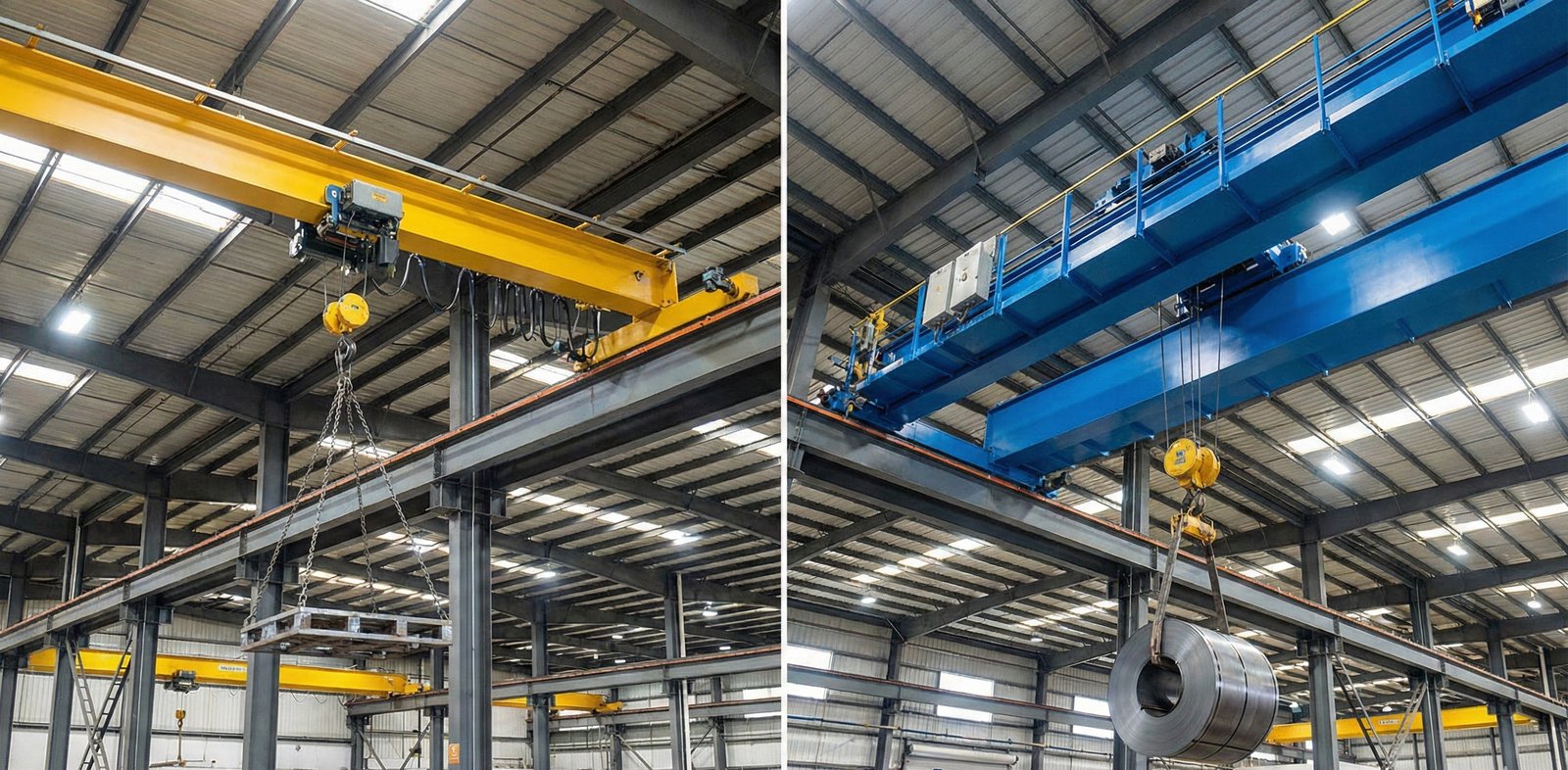
Quick Answer
Choose a single girder EOT crane when the load is light to medium, span is moderate, duty is not severe, budget matters, and building height is enough. Choose a double girder EOT crane when capacity, span, lift height, duty cycle, maintenance access, or production criticality is high. The lowest quote is not the safest answer unless both vendors have quoted the same duty, components, runway assumptions, controls, and acceptance scope.
Most buyers compare single girder and double girder cranes only by purchase price. That is where mistakes start. The right choice depends on the job the crane must perform every day: how much it lifts, how far it travels, how often it works, how high the hook must rise, and how easy it will be to inspect and maintain after installation.
This guide is written from a buyer's point of view. You do not need to become a crane designer. You need to know what to ask, what to compare in the quotation, and where a cheap option can become expensive later.
Simple Decision Rule
Single Girder
- Light to medium capacity requirement.
- Moderate span and simple plant layout.
- Enough building height for the required lift.
- Lower budget and lower building load are important.
- Maintenance can be handled with access equipment.
Double Girder
- Higher capacity or longer span.
- Maximum hook height is needed.
- Heavy duty, frequent operation, or three-shift use.
- Walkway or easier maintenance access is required.
- Production loss from downtime would be costly.
Quick Selector: Which Crane Should You Start With?
Use this as a first-pass buyer screen before asking suppliers for quotations. It is not a design approval, but it helps you avoid asking for the wrong crane type at the RFQ stage.
| Buying Situation | Start With | Why |
|---|---|---|
| Light workshop, stores, maintenance bay, moderate span | Single girder | Usually lower dead weight, lower cost and simpler installation. |
| Low headroom but high hook height requirement | Compare both, often double girder | Double girder can recover usable lift height, but the final choice depends on the exact hoist/trolley arrangement. |
| Long span, heavy load, frequent production use | Double girder | Better stiffness, duty suitability, maintenance access and long-term stability. |
| Existing building with limited runway/column capacity | Start with single girder, then verify | Lower dead load may reduce civil strengthening risk, but wheel loads still need checking. |
| Future capacity increase is likely | Evaluate double girder early | Changing later can require runway, column, power supply and clearance changes. |
Single Girder vs Double Girder Comparison Table
| Parameter | Single Girder EOT Crane | Double Girder EOT Crane | Buyer Risk If Ignored |
|---|---|---|---|
| Typical cost | Lower upfront cost due to less steel and simpler structure. | Higher upfront cost due to two girders, crab/trolley, and heavier structure. | Cheapest quote may hide poor duty, weak components, or low hook height. |
| Capacity | Commonly used for light and medium capacity cranes. | Preferred for heavier capacities and demanding production cranes. | Under-sizing can cause deflection, wear, breakdowns, and unsafe operation. |
| Span | Works well for moderate spans when deflection is controlled. | Better for longer spans where stiffness and stability matter more. | Long span with weak selection can create sway, alignment issues, and fatigue. |
| Hook height | Lower effective lift because the hoist usually hangs below the girder. | Higher effective lift because the hook can travel between the girders. | You may buy a crane that cannot lift high enough for your actual work. |
| Dead weight | Lighter, usually easier on runway beams and building columns. | Heavier, so runway beams and columns must be checked carefully. | Building strengthening can become an unexpected cost after vendor selection. |
| Maintenance | Access may need a lift, ladder, platform, or shutdown planning. | Can include walkway/platforms for better access to motors, brakes, panels. | Low maintenance access increases downtime and unsafe maintenance practice. |
| Duty class | Good for light to medium duty when designed correctly. | Better suited for heavy, frequent, or process-critical operation. | A low-duty crane in high-duty service fails early even if capacity is correct. |
Cost Difference: What You Are Really Paying For
A double girder crane can cost more because of additional steel, heavier end carriages, a crab/trolley arrangement, more complex fabrication, greater transport effort, and stronger runway requirements. But the extra cost may be justified when it protects hook height, stability, duty life, and maintenance access.
A single girder crane can be the better business decision when the application is simple. It keeps capital cost lower, reduces dead load on the building, and is usually faster to fabricate and install. The mistake is choosing single girder only because it is cheaper, without checking whether it can meet lift height, span, and duty requirements.
Hook Height and Headroom: The Point Buyers Miss
Hook height means the maximum height your hook can reach. In a single girder crane, the hoist is usually below the bridge girder, so some building height is consumed by the girder and hoist arrangement. In a double girder crane, the trolley can run on top of the girders and the hook can rise between them, often giving better usable lift.
This matters when you need to load machines, stack material, lift dies, handle tanks, or clear tall equipment. A crane that is technically cheaper but loses usable hook height can slow your production for years.
Capacity, Span, and Duty: The Three Inputs That Decide the Crane
1. Capacity
Capacity is not only the heaviest load you lift once. Buyers should consider regular load, occasional maximum load, lifting attachments, future capacity needs, and whether the crane will be used near rated load frequently.
2. Span
Span affects girder deflection, weight, wheel loads, and cost. A longer span can make single girder less attractive even at the same capacity because stiffness and deflection become more important.
3. Duty Class
Duty is about how hard the crane works. Two cranes with the same capacity can have very different lives if one runs occasionally and the other runs all day. If your crane is used in production, dispatch, steel handling, foundry, fabrication, or process lines, discuss duty class clearly in the RFQ.
How to Compare Vendor Quotes Fairly
For procurement teams, the biggest danger is comparing two quotes that are not technically equal. One vendor may quote a lower-duty hoist, cheaper brake, basic controls, no radio remote, no proper overload protection, or exclude load testing and documentation. The quote looks cheaper, but the scope is weaker.
| Quote Item | What to Ask | Why It Matters |
|---|---|---|
| Main girder | Plate/section details, design standard, deflection basis, painting system. | Controls stiffness, life, corrosion resistance, and long-term reliability. |
| Hoist/crab | Type, make, duty, lift speed, reeving, rope/drum details. | Often the heart of the crane and a major source of downtime. |
| Motors and brakes | Make, rating, insulation, duty, brake type, brake torque margin. | A low-cost brake or motor can create safety and service issues. |
| Controls | VFD/contactor, panel make, protection, radio remote, pendant station. | Affects smooth movement, safety, maintenance, and operator productivity. |
| Scope | Runway, DSL, erection, commissioning, load test, transport, taxes. | Prevents surprise costs after PO release. |
Common Buyer Mistakes
- Choosing single girder only because the quote is lower.
- Ignoring hook height until installation stage.
- Not checking runway beam and column capacity before choosing double girder.
- Comparing quotes without normalizing hoist, brake, gearbox, DSL, controls, and safety devices.
- Not specifying duty class and actual operating cycle.
- Leaving FAT, SAT, load test, documents, and handover requirements unclear.
Practical Recommendation
If your crane is a normal workshop crane, light fabrication crane, store crane, or occasional maintenance crane, start by evaluating single girder. If your crane is production-critical, high-capacity, long-span, frequently used, or hook-height sensitive, start by evaluating double girder.
Before releasing the PO, ask vendors to fill the same RFQ format and compare the same BOM/makes. That one step will protect you from most poor buying decisions.
Use This Before Asking for Prices
Define capacity, span, lift, duty, controls, safety, BOM makes, acceptance scope, and vendor assumptions before collecting quotes. This makes vendor comparison much cleaner.
FAQs
Which crane is better for low building height?
Double girder can provide better hook height in many cases because the hook can rise between the girders. However, final headroom depends on the exact hoist/trolley arrangement and building layout.
Is double girder always stronger?
Double girder is generally selected for higher capacity, longer span, and heavier duty, but a well-designed single girder crane can be completely suitable for many applications. Strength depends on design, fabrication, duty, and component selection.
Can I upgrade from single girder to double girder later?
Sometimes, but it is not a simple swap. Runway beams, columns, electrification, clearances, and foundations may need checking. If future capacity increase is likely, mention it during the RFQ stage.
What should I ask vendors before deciding?
Ask for capacity, span, lift, duty class, hoist/crab make, motor and brake make, gearbox details, control system, safety devices, wheel loads, deflection basis, paint system, warranty, exclusions, erection scope, load test, and handover documents.