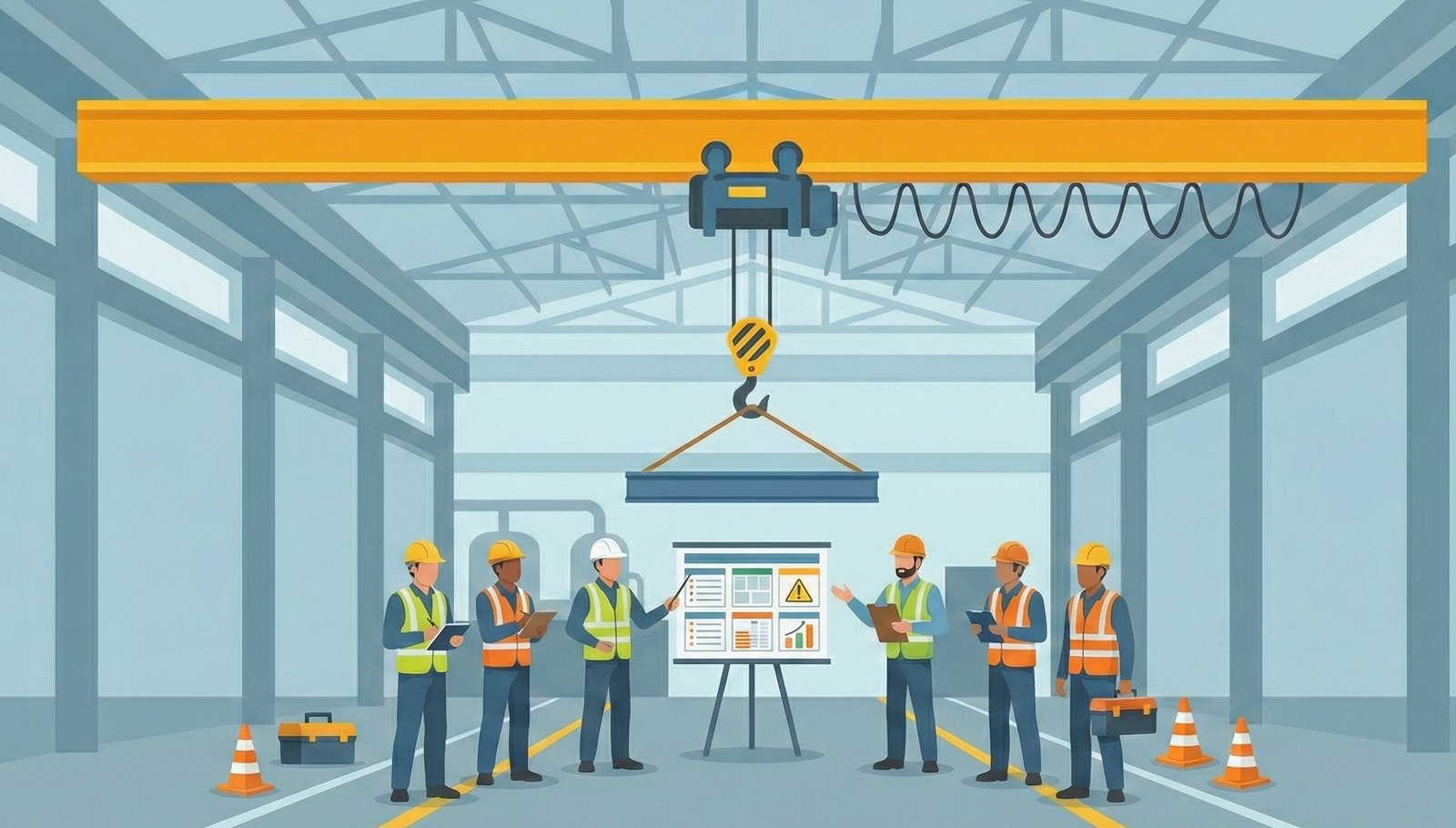
What Is "Two-Blocking" and Why Is It Fatal?
In crane terminology, Two-Blocking occurs when the bottom hook block travels too high and crashes physically into the upper drum or trolley frame sheaves.
When the hook block hits the rigid steel frame, physical travel stops instantly. But the 15–40 kW hoist motor and heavy high-inertia gear train continue to rotate at full speed. In less than 0.3 seconds:
- The static rope tension jumps from its normal rated load (e.g. 50 kN) to the motor's full Breakdown Torque limit (exceeding 300–500 kN).
- The wire rope stretches past its yield point and shears instantaneously.
- The heavy bottom block (often weighing 200 kg to over 1,500 kg) and the suspended payload plummet freely to the ground.
The Documented Failure Modes: Why Upper Limit Switches Fail
Forensic reviews of public accident reports from OSHA, ASME B30, and the Mine Safety & Health Administration (MSHA) reveal three primary technical causes for two-blocking disasters:
3-Phase Power Reversal Bypassing Rotary Limits (MSHA Hazard Bulletin)
Following electrical maintenance or busbar shoe replacement, if two supply phases (L1 and L2) are accidentally swapped:
- The operator presses the "DOWN" button on the pendant or radio remote.
- Because the 3-phase sequence is inverted, the hoist motor turns backwards and runs UPWARD at full speed.
- Because the "DOWN" contactor coil is energized, the geared rotary upper limit switch (which is wired in series with the "UP" contactor) is completely bypassed by the electrical circuit.
- The hook block smashes into the drum with full power.
Lack of Shift-Start Testing & Seized Mechanical Linkages
In OSHA Accident Report #202005518, the auxiliary hoist upper limit switch failed because mechanical corrosion and internal contact welding prevented the switch from opening when struck. The investigation noted that the mandatory daily pre-shift limit switch test had not been performed prior to operation.
Counterweight Displacement / Sliding Weight Failure
In OSHA Accident Report #971176, the counterweight of a gravity-operated limit switch became misaligned and slid along the wire rope without tripping the internal electrical contact, allowing the hook to travel past the safe threshold and snap the cable.
How Phase Reversal Bypasses Geared Rotary Limit Switches
Operator Presses "DOWN"
Energizes the "DOWN" Contactor Coil (K2) in the crane panel as intended.
Reversed Supply (L1 ↔ L2)
Because supply phases are swapped, the 3-phase motor rotates in reverse and spins UPWARD at full speed.
Rotary Switch Bypassed!
The Upper Limit Switch contact is in the "UP" coil line (K1). Because K1 was never energized, the circuit never breaks!
The Documented Failure Modes: Why Upper Limit Switches Fail
Forensic reviews of public accident reports from OSHA, ASME B30, and the Mine Safety & Health Administration (MSHA) reveal three primary technical causes for two-blocking disasters:
3-Phase Power Reversal Bypassing Rotary Limits (MSHA Hazard Bulletin)
Following electrical maintenance or busbar shoe replacement, if two supply phases (L1 and L2) are accidentally swapped:
- The operator presses the "DOWN" button on the pendant or radio remote.
- Because the 3-phase sequence is inverted, the hoist motor turns backwards and runs UPWARD at full speed.
- Because the "DOWN" contactor coil is energized, the geared rotary upper limit switch (which is wired in series with the "UP" contactor) is completely bypassed by the electrical circuit.
- The hook block smashes into the drum with full power.
Lack of Shift-Start Testing & Seized Mechanical Linkages
In OSHA Accident Report #202005518, the auxiliary hoist upper limit switch failed because mechanical corrosion and internal contact welding prevented the switch from opening when struck. The investigation noted that the mandatory daily pre-shift limit switch test had not been performed prior to operation.
Counterweight Displacement / Sliding Weight Failure
In OSHA Accident Report #971176, the counterweight of a gravity-operated limit switch became misaligned and slid along the wire rope without tripping the internal electrical contact, allowing the hook to travel past the safe threshold and snap the cable.
How Phase Reversal Bypasses Standard Rotary Limit Switches
The Prevention Blueprint: How to Immunize Your Cranes
To eliminate two-blocking risks completely, ASME B30.2, IS 3177, and OSHA guidelines mandate a 3-tier defensive architecture:
Phase Sequence Relay (PSR) in Every Panel
An electronic Phase Sequence & Phase Failure Relay installed on the crane's incoming power feed detects phase inversions within 50 milliseconds and locks out the main power contactor, preventing motors from running in reverse.
Dual Upper Limit Architecture (Rotary + Gravity Weight)
Level 1 (Service Limit): Geared rotary switch on the drum shaft cuts the control circuit at normal maximum height.
Level 2 (Emergency Power Limit): A direct-acting gravity counterweight limit switch physically cuts main contactor power when lifted by the hook block, operating independently of control wiring.
Mandatory Shift-Start Limit Switch "Inch Test"
Per OSHA 29 CFR 1910.179(n)(4)(i), crane operators must slowly inch the empty hook up to the upper limit switch at the start of every shift to verify that the switch cuts power before any load is rigged.
Related Engineering Tools & Specifications
Verify your crane wire rope safety factors and braking torque to withstand accidental dynamic overloads:
Wire Rope Sizing Tool
Calculate wire rope safety factor (5x–8x) and minimum breaking force.
Brake Torque Calculator
Determine required holding torque safety factors (1.5x–2.5x) for hoists.
ISO 4309 Discard Guide
Inspection criteria for broken wires, diameter reduction, and core damage.
Free RFQ Template
Pre-built procurement clause specifying dual rotary + gravity limit switches.
Ensure Your Crane Specifications Are Bulletproof
Download our free EOT crane technical RFQ specification template with built-in safety interlock clauses to protect your procurement.
Download Free RFQ Template