DSL / shrouded busbar
Common for runway power along the bay. It needs proper current rating, joints, expansion, feed point and collectors.
Check: ampere rating, voltage drop, bay length, number of cranes, shrouding and support spacing.
A crane can be mechanically sound and still fail daily because the moving power supply is underspecified. Define DSL, busbar, festoon, collectors, feed points, current rating and voltage drop before comparing quotations.
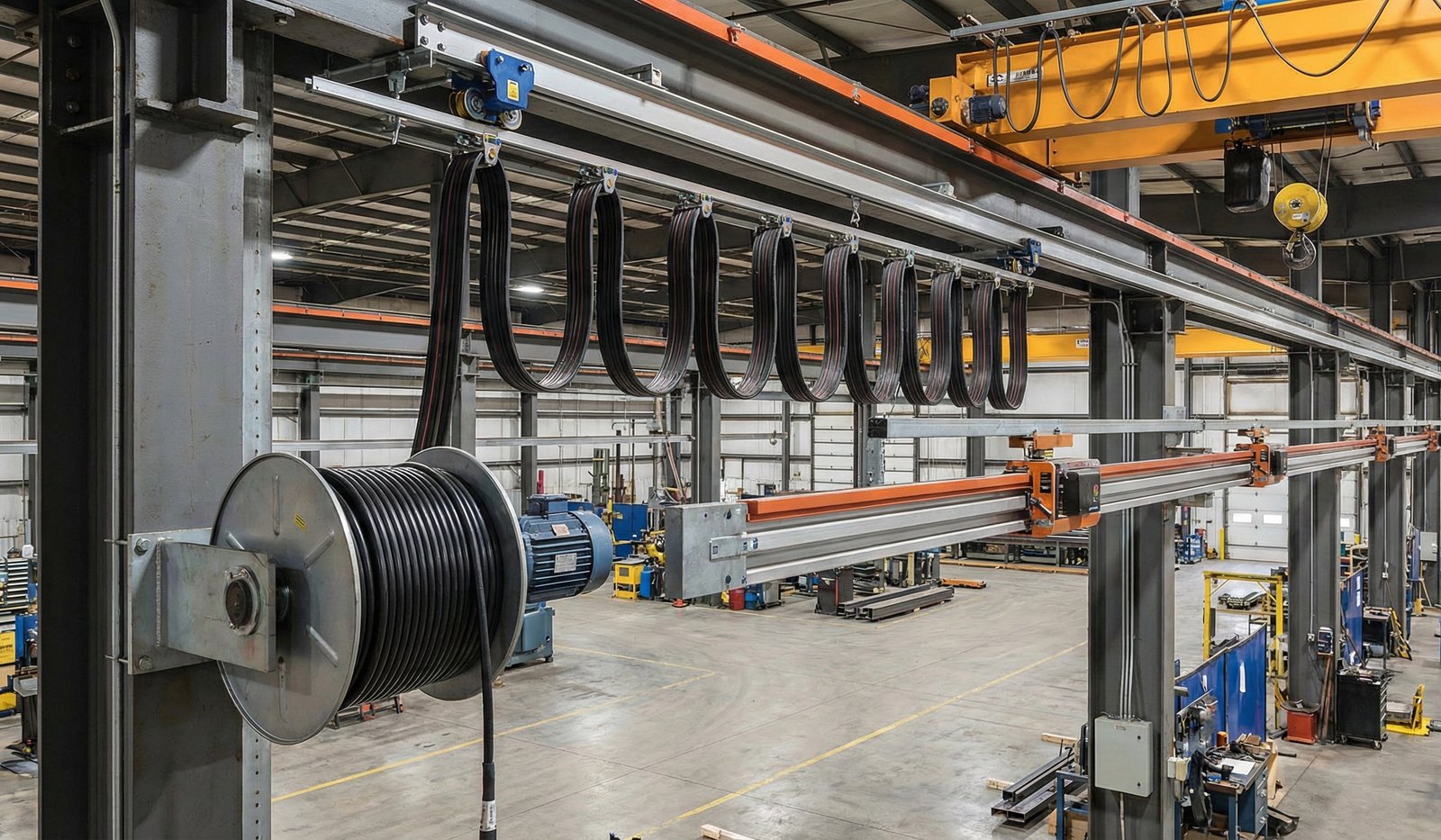
For crane electrification, do not compare only the ampere rating. Ask for DSL/busbar type, current rating, voltage-drop basis, feed location, number of cranes, simultaneous operation assumption, conductor length, collector shoe details, joints, expansion, shrouding, earthing, festoon cable scope and installation responsibility.
Long-travel runway power, trolley power and auxiliary/control power may use different systems. A good RFQ states where power terminates and what the crane supplier must provide beyond that point.
Common for runway power along the bay. It needs proper current rating, joints, expansion, feed point and collectors.
Common for hoist/trolley movement where flexible cable loops move with the trolley or bridge.
The best busbar can still fail if collector shoes, joints, feed points and alignment are weak.
| Item | Ask the supplier to state | Why it matters | Red flag |
|---|---|---|---|
| Supply boundary | Incoming power termination point, purchaser scope and supplier scope. | Prevents later disputes over cabling, isolator, DSL or commissioning power. | "Power by client" with no boundary. |
| Current rating | Crane current, number of cranes, simultaneous demand and diversity assumption. | Multiple cranes sharing a bay can overload weak assumptions. | One crane current used for full bay. |
| Voltage drop | Conductor length, feed location, conductor material/size and allowed voltage drop. | Voltage drop causes weak motion, trips and contactor chatter at far end. | No voltage-drop calculation. |
| DSL/busbar scope | Busbar make, rating, poles, shrouding, joints, expansion, supports and end caps. | Small accessories decide reliability and safety. | Only "DSL included" stated. |
| Collector shoes | Make/model, rating, quantity, spare shoes, alignment and spring-pressure checks. | Collectors are common sparking and intermittent-power points. | No collector details or spare plan. |
| Festoon scope | Cable type, cores, trolley system, bend radius, loop depth and junction boxes. | Moving cable failures are frequent when loops and clamps are wrong. | Festoon treated as generic cable. |
| Acceptance tests | Insulation, earthing, continuity, voltage at far end, collector travel and load trial. | Confirms electrical reliability before production use. | No SAT electrical checks. |
Ask every bidder to state current, feed point, conductor length, voltage-drop basis, collectors, festoon scope and installation responsibility.