Operator confusion
Require clear button order, labels and motion logic so operators do not guess during lifting or travel.
Check pendant button layout, emergency stop, enclosure rating, cable support and operator ergonomics before accepting a crane control system.
Quick answer
A crane pendant station should clearly define movement buttons, speed steps, emergency stop, control voltage, enclosure rating, cable length, cable strain relief, pendant support and labeling. Do not treat the pendant as a minor accessory: poor controls create operator confusion, cable damage, unsafe positioning and repeated downtime.
Require clear button order, labels and motion logic so operators do not guess during lifting or travel.
Check strain relief, pendant support, cable travel and bending so the pendant cable is not carrying abuse.
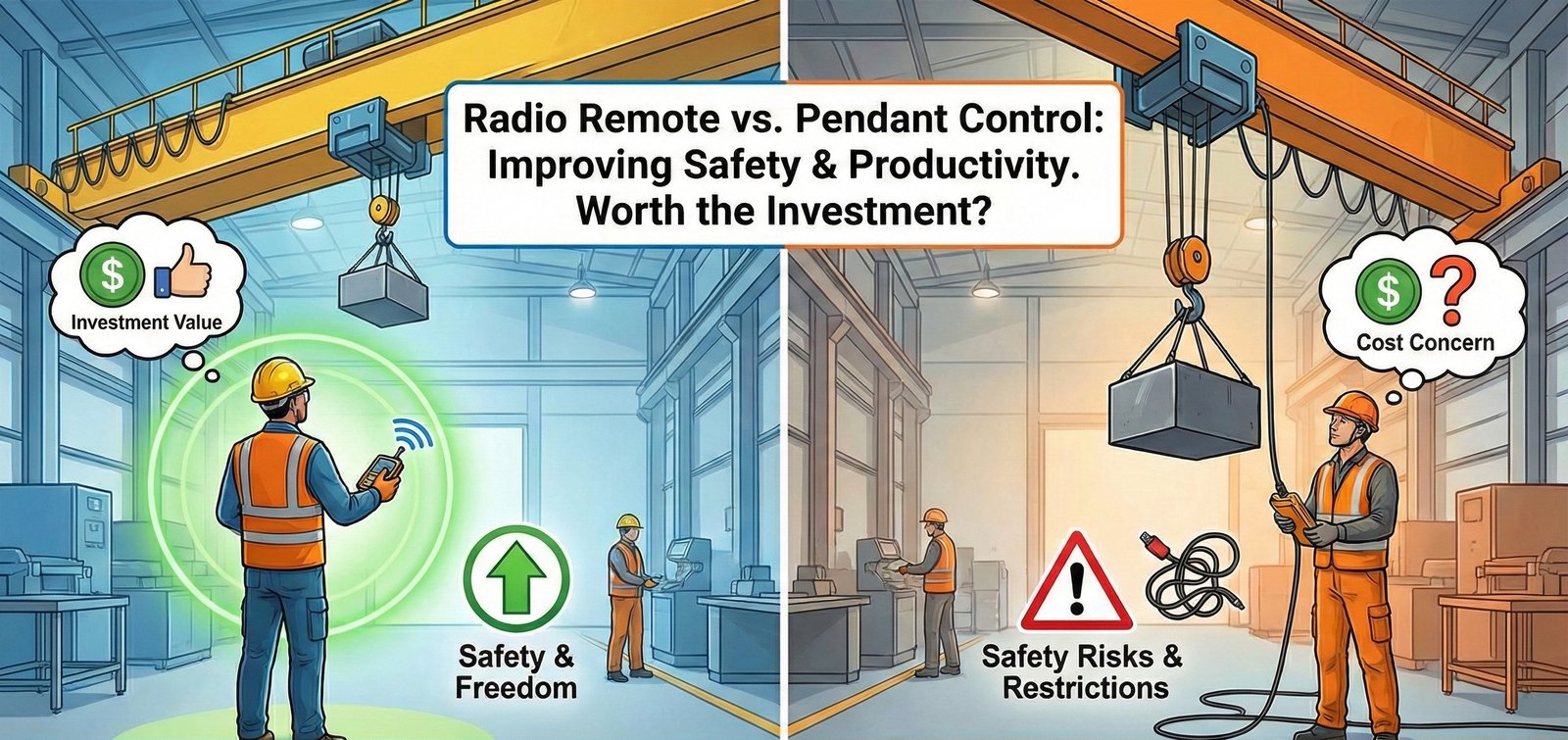
Compare pendant and radio remote based on visibility, distance, duty, traffic and operating environment.
| Field | What to ask | Why it matters | Red flag |
|---|---|---|---|
| Button layout | Up/down, cross travel, long travel, start, stop and emergency stop arrangement. | Clear movement logic reduces operating mistakes. | Only "pendant included" stated. |
| Speed control | Single speed, two speed, stepless/VFD command or creep speed details. | Control type affects positioning accuracy and operator handling. | No speed-control basis shown. |
| Emergency stop | Mushroom emergency stop, latching behavior and reset philosophy. | Emergency stop must be accessible and clearly functional. | Emergency stop not separately specified. |
| Control voltage | Confirm control voltage and panel compatibility. | Low-voltage control is commonly preferred for safer operator interface. | Control voltage missing. |
| Enclosure rating | Dust/water protection, indoor/outdoor suitability and chemical/heat exposure. | Wrong enclosure leads to sticky buttons, ingress and failure. | Generic pendant with no rating. |
| Cable and support | Cable length, cores, strain relief, support wire/chain and festoon/trolley relation. | Cable damage is a common practical failure point. | Cable hangs under its own load. |
| Operator position | Where the operator stands, visibility, travel path and obstruction risk. | Controls should match the actual way the crane is used. | No site-use review. |
Send this when pendant control details are missing in a crane quotation.